
📖 Japan Stories | 🧰 The Japan Edit
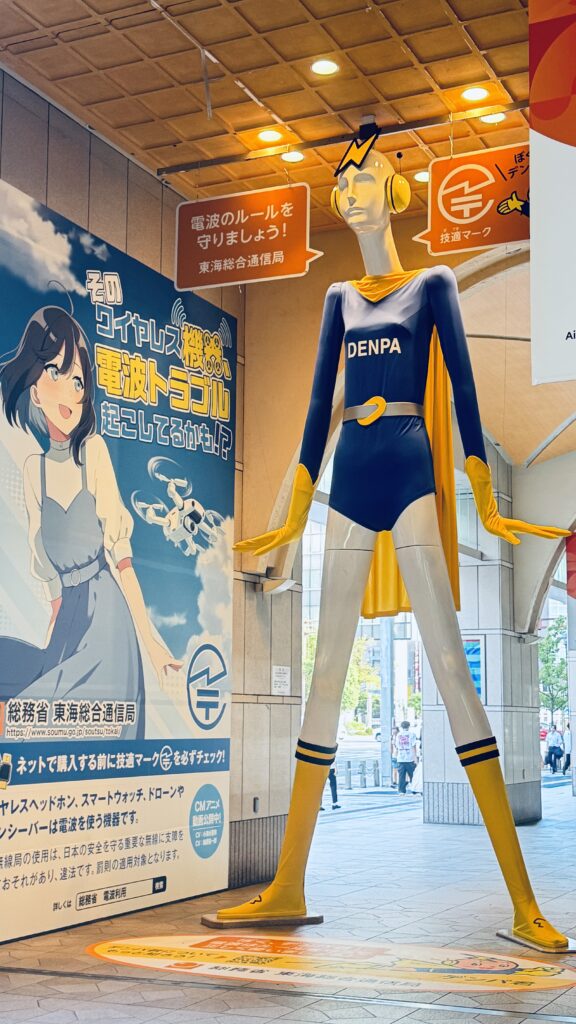
I’ve walked past her more times than I can count. Six meters tall, standing outside Nagoya Station since before I was born, wearing whatever some brand paid her to wear that week — a swimsuit, a Santa dress, once an anime character I didn’t recognize. She’s just part of the skyline at this point. You stop really seeing her.
Except this time.
This time she had a lightning bolt painted across her forehead, giant yellow headphones over her ears, a cape, and the word “DENPA” printed across her chest in block letters. I actually stopped walking.
Turns out I wasn’t the only one confused. A woman next to me was taking a photo and muttering “denpa… like, wifi?” to no one in particular.
Close, actually.
Her name is Nana-chan, and she’s been Nagoya’s unofficial mascot since 1973 — built for a department store’s first anniversary, kept around because nobody could imagine the station without her. Normally she’s a walking billboard: whichever company books the week gets to dress her. But the outfit I walked into wasn’t sponsored by a company at all. It was sponsored by the Japanese government.
Specifically, by the people in charge of radio waves.
She was playing “Denpa-kun” — a superhero character the telecom ministry invented back in 1994, whose entire job is fighting illegal radio signals. He got his name through a public naming contest in 1996, and every year around Radio Day, Nagoya’s most photographed mannequin gets recruited to play him for a week, right outside the station, next to actual government signage about something called the 技適 (gi-teki) mark.
I’ll admit, my first reaction was: only in Japan does a government safety campaign involve dressing a giant mannequin as a lightning-bolt superhero. But the message underneath is genuinely useful, especially if you’re the kind of person who travels with gadgets.
That little 技適 mark is what tells you a wireless device — a walkie-talkie, a ham radio, some drone controllers — has been certified to legally transmit here. Bring one without it, and technically, you’re breaking the law the moment you turn it on. Most tourists will never run into this. But if you’re the type who packs a two-way radio for hiking, or brings your own drone, it’s worth a five-second check before you fly.
What actually got me, standing there, wasn’t the superhero costume. It was the fact that an entire government office thought a slightly ridiculous mascot was the best way to get people to care about something as dry as “radio wave compliance” — and it’s worked well enough that they’ve done it for years. Back when I was going back and forth to Malaysia, “public awareness campaign” usually meant a pamphlet nobody read. Here, it means recruiting the most photographed object in the city and letting people find out for themselves, one confused tourist at a time.
She’ll be back in her regular rotation by next week — some new brand, some new outfit, probably something nobody remembers a month later. But for one week in September, Nagoya’s biggest mannequin was, technically, a federal employee.